
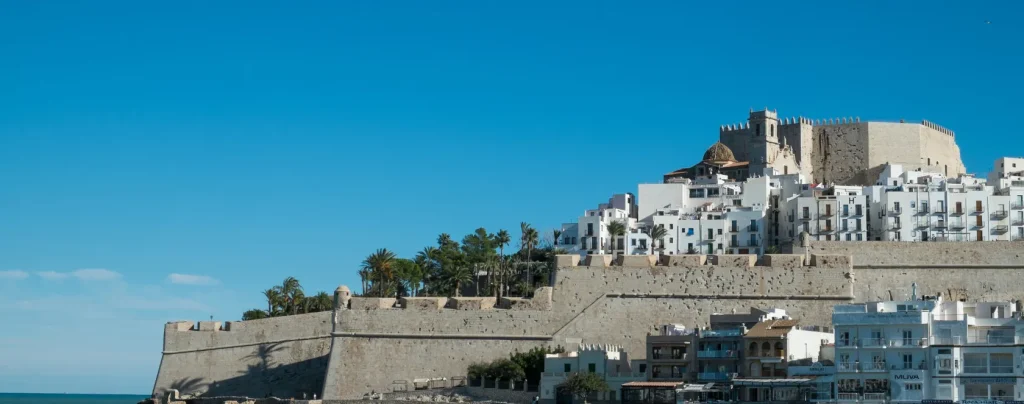
Peñíscola is a municipality in the Valencian Community, located in the province of Castellón. It is known for its old town, its castle, and its beautiful beaches, making it a popular tourist destination. The history of Peñíscola dates back to prehistoric times and has been influenced by various civilizations. Its cultural and geographical richness offers a wide variety of activities for all visitors.
PREHISTORIC ORIGINS
Archaeological remains in the vicinity of Peñíscola attest to the presence of populations since prehistoric times. In the Poaig and Els Barrancs sites, tools and remains have been found that evidence the occupation of human groups dedicated to hunting and gathering, as well as the development of Iberian communities. These early inhabitants carried out economic activities that favored interactions with Phoenician merchants, who introduced new techniques and products to the region.
ROMAN AND MUSLIM ERA
During the Roman era, Peñíscola, known as “Castrum”, became an important settlement thanks to its strategic location as a commercial port. This period was characterized by the development of infrastructure such as roads and buildings. With the arrival of the Muslims in the 8th century, the city maintained its relevance, being a center of trade and culture. The Arab influence is evident in the architecture and urban planning, leaving visible traces in the layout of its streets and buildings.
THE RECONQUEST AND THE CASTLE OF PAPA LUNA
Peñíscola was reconquered in 1233 by King James I of Aragon. During this period, a new chapter in its history began, marked by demographic and economic growth. One of the most representative symbols of this era is the Castle of Papa Luna, built between 1294 and 1307 on the remains of an old Arab fortress. This castle not only served as a military fortification but also as the residence of Pope Benedict XIII, known as Papa Luna, establishing itself as an outstanding historical and heritage landmark.
EVOLUTION TO THE PRESENT DAY
Throughout the centuries, Peñíscola has evolved significantly. The arrival of tourism in the 20th century boosted its economic development, turning the town into an attractive destination for visitors from all over the world. Today, the historical, cultural, and natural heritage of Peñíscola continues to be an object of conservation and promotion, ensuring that its rich legacy is appreciated by future generations. Local festivities, gastronomy, and historical architecture are part of its essence, attracting those looking to experience its living history.
PEÑÍSCOLA AS A HOLIDAY DESTINATION
Excursions and hiking trails The Sierra de Irta offers simple and accessible routes so that families can enjoy nature. These excursions allow you to get to know the natural environment and do healthy activities.
Water activities The beaches of Peñíscola are perfect for enjoying water activities such as paddle surfing, kayaking, or simply swimming. Many centers offer courses and equipment rental suitable for all ages.
Outstanding family events Peñíscola is also filled with special activities throughout the year. Festivals and events involving the whole family are held, creating a festive and participatory atmosphere.
International theater festival During this event, open-air plays suitable for all audiences are performed. Actors often involve the children, allowing them to enjoy the experience actively.
Medieval market This annual event transforms the streets of Peñíscola into a true journey into the past. Children can enjoy typical activities and shows by jugglers, puppeteers, and other street performers.
Do you want to know more about Peñíscola? We wait for you at our hostel so you can enjoy your vacation.